
The Federal Reserve is a Failure
Thesis & Fact Part 2
Also see “Thesis & Fact – Derivatives” (Part 1)
By Mitchell Vexler, April 19, 2025 (as re-edited & re-posted here January 13, 2026)
See the Report from the Office of the Inspector General:
https://oig.federalreserve.gov/reports/Cross_Cutting_Final_Report_9-30-11.pdf
The Report is well written and very detailed. Notice the Date of September 2011.
Report concerns the analysis of failed State Member Banks and how to define processes to prohibit such failures in the future.
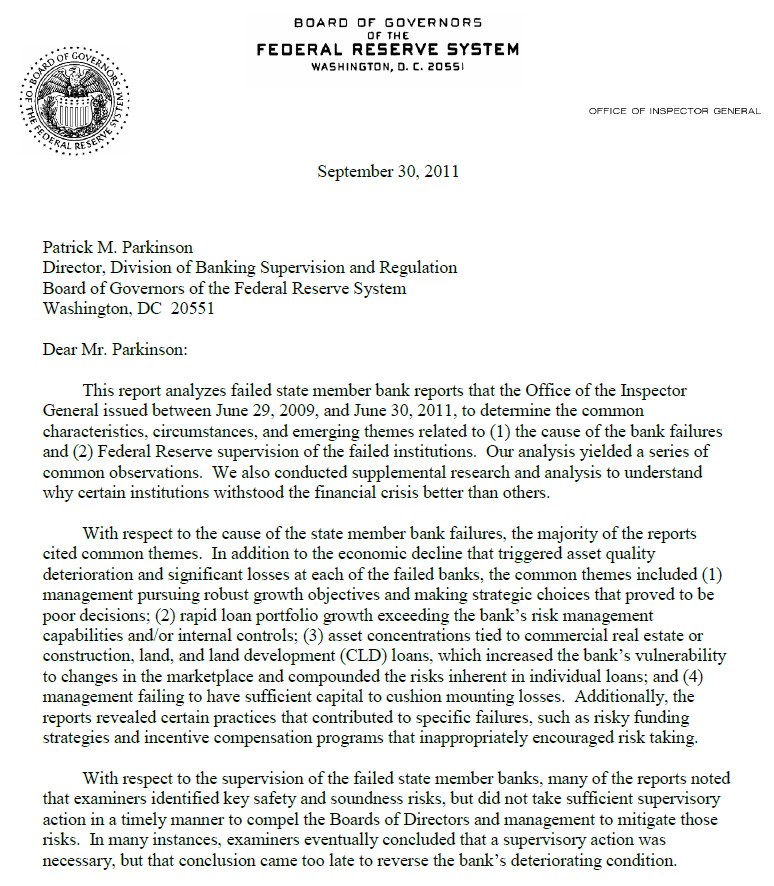
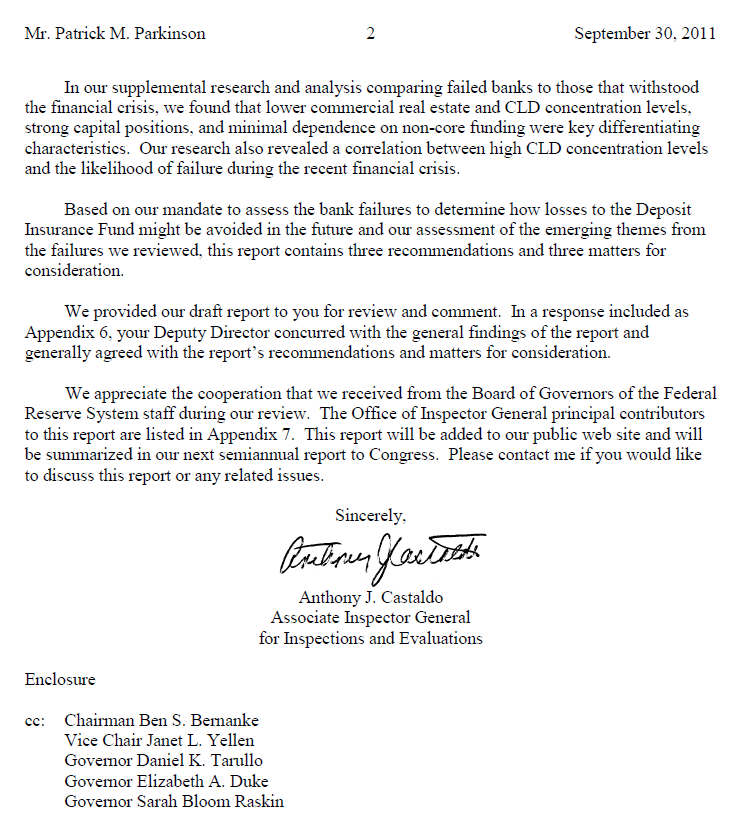
Below is the September 30th letter from Associate Inspector General Castaldo outlining the cause of the bank failures.
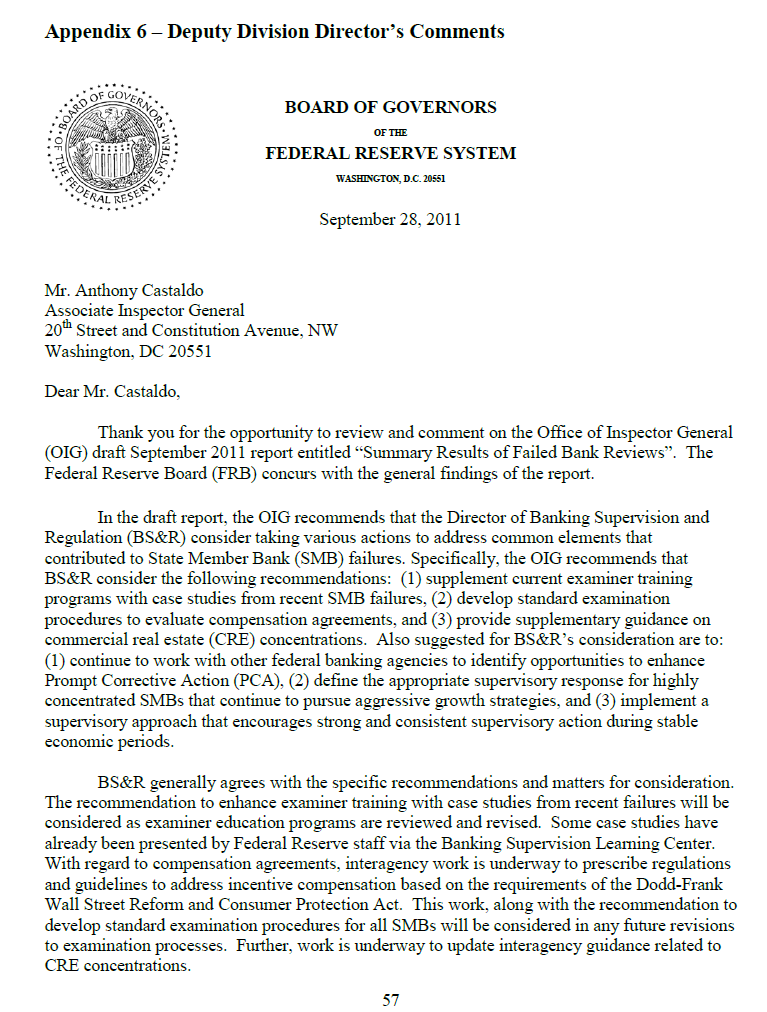
Prior to the letter above, a September 28th letter that was written to Associate Inspector General Castaldo. This September 28th letter outlines multiple recommended courses of actions, of which to this day, none were followed.
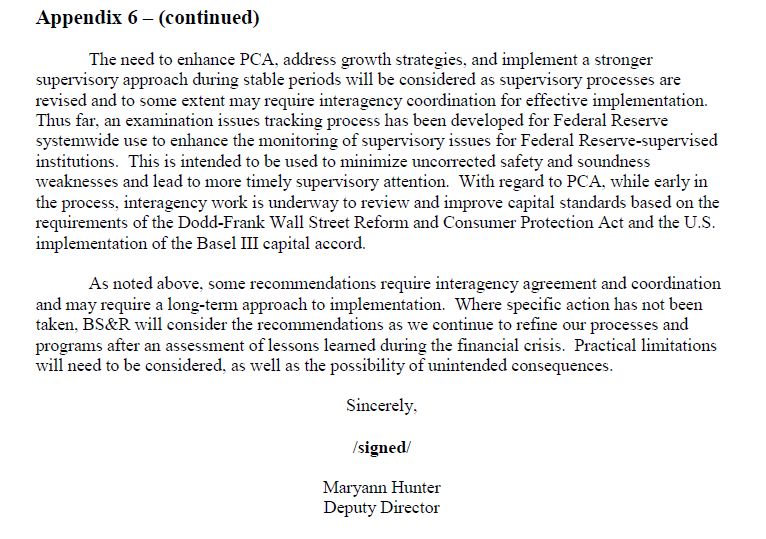
Let me restate the exact text from above response which is the reason for the failure of the Federal Reserve which is clearly stated in this Report and which is the failure to enforce any requirements as seen below:
In the draft report, the OIG recommends that the Director of Banking Supervision and Regulation (BS&R) consider taking various actions to address common elements that contributed to State Member Bank (SMB) failures. Specifically, the OIG recommends that BS&R consider the following recommendations: (1) supplement current examiner training programs with case studies from recent SMB failures, (2) develop standard examination procedures to evaluate compensation agreements, and (3) provide supplementary guidance on commercial real estate (CRE) concentrations. Also suggested for BS&R’s consideration are to: (1) continue to work with other federal banking agencies to identify opportunities to enhance Prompt Corrective Action (PCA), (2) define the appropriate supervisory response for highly concentrated SMBs that continue to pursue aggressive growth strategies, and (3) implement a supervisory approach that encourages strong and consistent supervisory action during stable economic periods.
BS&R generally agrees with the specific recommendations and matters for consideration. The recommendation to enhance examiner training with case studies from recent failures will be considered as examiner education programs are reviewed and revised. Some case studies have already been presented by Federal Reserve staff via the Banking Supervision Learning Center. With regard to compensation agreements, interagency work is underway to prescribe regulations and guidelines to address incentive compensation based on the requirements of the Dodd-Frank Wall Street Reform and Consumer Protection Act. This work, along with the recommendation to develop standard examination procedures for all SMBs will be considered in any future revisions to examination processes. Further, work is underway to update interagency guidance related to CRE concentrations.
The above response is political ass-covering, double speak, and a giant middle finger to Congress and the Citizens of the United States of America.
What did the Federal Reserve do about the requirements… NOTHING. Except, continue to blow the fraud bubble even larger.
Where are we today? We are facing the largest economic catastrophe the globe has ever known which is the creation of the fraud and debt bubble and the derivatives thereon all of which are cumulatively compounding.
By not following this single well written Report, at a minimum the Federal Reserve should have its doors chained shut for Contempt.
Let’s consider some more recent events.
In March 2023, the Federal Reserve responded to the failures of Silicon Valley Bank (SVB) and Signature Bank. It joined other regulators in lifting the $250,000 per account deposit insurance for customers of those two banks, described in more detail in “How does deposit insurance work?”
What is a lender of last resort?
Banks, in general, take deposits from their customers (who often can take their money out whenever they want) and put the money into loans or securities (often longer-term commitments that sometimes cannot be easily sold). In normal times, when most depositors are content to leave their money in the bank, this works well. Banks are required by law to maintain a portion of deposits in cash so that they can meet customer demands for withdrawal.
However, if depositors withdraw a lot of money at once, the bank may not have enough cash on hand to satisfy them. This can happen if depositors lose confidence in the bank’s ability to meet all withdrawal demands so every depositor tries to be at the head of the line – a run on the bank, a phenomenon explained by economists Douglas Diamond and Philip Dybvig for which they shared a Nobel Prize in 2022. If the bank cannot borrow money, it may be forced to call its loans or sell other assets quickly, sometimes at a loss, to raise cash. A lender of last resort – a central bank like the Federal Reserve – provides loans to banks so they can meet depositor demands. The banks pledge collateral – bonds, loans or other assets – so the central bank isn’t at risk of losing money.
What is the Bank Term Funding Program?
The Bank Term Funding Program (BTFP) is a lender of last resort facility. It was created in March 2023, after the failures of Silicon Valley Bank and Signature Bank, to lend to other banks that had big unrealized losses on their holdings of government bonds and were, therefore, at risk of large-scale withdrawals of deposits. The facility allows banks to exchange assets such as U.S. Treasuries for cash at their full-face amount, regardless of the current market value. These loans are allegedly for up to one year at an interest rate equal to the one-year overnight index swap (OIS) rate, plus 0.10 percentage points. This rate varies daily. As of April 28, 2023, the BTFP rate was 4.92%. As of May 8, the BTFP rate was 4.81%. As of May 3, banks borrowed $75.8 billion through the Bank Term Funding Program, down from $81.3 billion the week before.
The Treasury has earmarked $25 billion to backstop the BTFP, but the Fed said it does not anticipate it will have to draw on that, which was at that time.
The Fed said in January 2024 that the BTFP would stop making loans, as scheduled, on March 11, 2024. It also adjusted the interest rate on any new loans to be no lower than the interest rate that the Fed pays on bank reserves. Until that change, some banks borrowed heavily at the BTFP and deposited the funds as reserves at the Fed at a higher interest rate to make a profit. As that maneuver became more attractive, bank borrowing from the program rose from about $100 billion in June 2023 to $161.5 billion in mid-January 2024.
What is the discount window?
The Fed traditionally exercises its lender of last resort function through the discount window, a permanent facility that lends cash to banks, often for just a few days or weeks. The banks pledge collateral to the Fed but, unlike the BTFP, the Fed will not lend against the full-face value of the bond or loan; instead, it lends up to the market value of the security or loans and, in some cases, takes what’s known as a haircut to make sure the collateral is sufficient to cover the loan. Until recently, the Fed imposed a haircut between 1% and 5% on Treasuries, agency debt (Fannie Mae and Freddie Mac), and mortgage-backed securities, but it eliminated those haircuts after the Silicon Valley Bank collapse. The discount rate, the interest that banks pay on these loans, is set by the Federal Reserve Board.
The discount rate, the interest that banks pay on these loans, is set by the Federal Reserve Board. As of May 8, it was 5.25%.
Banks are sometimes reluctant to borrow at the discount window because, if word gets out, it may suggest that the bank is in trouble. Borrowing at the discount window soared from $4.6 billion on March 9 to $152.9 billion on March 15 and fell to $67.6 billion on April 12. This decrease was largely offset by increased borrowing through the Bank Term Funding Program. As of May 3, discount window borrowing was $5.3 billion, down sharply from $73.9 billion the week before, because the Fed’s substantial loans to First Republic were moved to another category on the Fed’s books—one that consists of loans to banks that have been taken over by the FDIC, including SVB, Signature Bank, and First Republic. These loans totaled $228.2 billion as of May 3.
The Bank Policy Institute, which represents U.S. banks, speculated that borrowing at the discount window was heavier than at the BTFP because banks had pre-positioned collateral at the discount window or because they were simply more familiar with borrowing at the discount window than through the new facility.
What are swap lines?
Many banks overseas borrow and lend in U.S. dollars. At times of financial stress, foreign banks often face demands for U.S. dollars that they can’t easily meet. Foreign central banks can print their own currencies – euros, yen, Swiss francs, British pounds – to lend to their cash-strapped banks, but they can’t print U.S. dollars. During the Global Financial Crisis, the Fed began a series of agreements with foreign central banks under which the Fed would swap U.S. dollars for foreign currencies with other central banks; the foreign central banks pay interest to the Fed. At the program’s peak, swaps totaled more than $580 billion, more than a quarter of all the Fed’s assets. Until March 2023, the Fed conducted these swaps once a week. As of May 3, the Fed had $410 million in these swaps outstanding. On March 19, 2023, it said it would begin daily swaps at least through the end of April “to improve the swap lines’ effectiveness.”
What about interest rates?
On March 22, the Fed raised its target for short-term interest rates by another ¼ percentage point to a range of 4.75% to 5%, but it significantly changed its guidance on future interest rates moves. Fed Chair Jerome Powell said in his press conference: “[W]e no longer state that we anticipate that ongoing rate increases will be appropriate to quell inflation; instead, we now anticipate that some additional policy firming may be appropriate.” In its statement, the Fed’s policy committee said, “The U.S. banking system is sound and resilient. Recent developments are likely to result in tighter credit conditions for households and businesses and to weigh on economic activity, hiring, and inflation. The extent of these effects is uncertain.”
What role did the Fed play in supervising Silicon Valley Bank?
The Federal Reserve – primarily the Federal Reserve Bank of San Francisco – was Silicon Valley Bank’s primary regulator. Signature Bank, a New York bank that also failed in March, was regulated primarily by the Federal Deposit Insurance Corporation (FDIC). Both banks also were overseen by state regulators.
What did the Fed’s review of its supervision of SVB find?
On April 28, Vice Chair for Supervision Michael S. Barr released a lengthy review of the Fed’s supervision and regulation of SVB. The Fed highlighted four causes of the bank’s failure:
SVB’s board of directors and management failed to manage their risks.
Fed supervisors did not fully appreciate the extent of the vulnerabilities as SVB grew in size and complexity.
When supervisors did identify vulnerabilities, they did not take sufficient steps to ensure that SVB fixed those problems quickly enough.
The Federal Reserve Board’s response to a 2018 law—the Economic Growth, Regulatory Relief, and Consumer Protection Act, which lightened the oversight of some mid-sized banks—and the shift in top Fed policymakers’ guidance to supervisors impeded effective supervision by reducing standards, increasing complexity, and promoting a less assertive supervisory approach.
No one knows the future, but as I have stated and shown there are ways to help model potential outcomes. Mahalanobis Study, Monte Carlo, Rule of 72, Amortization Schedules, Black Scholes, Bond Analysis etc. How could these tools not have been deployed in a uniform manner across the Member Banks unless by intent to ignore??
The Federal Reserve has failed to adopt and adhere to any rules and regulations and even if they did, a “situation” would arise to in their mind adjust to a “temporary rule”. From time to time attempts to call for goal posts one of which was using the Taylor Rule by John Taylor as suggested by Alan Meltzer and discussed by Greenspan, but the result over time has been…we will just move the goal posts all while be completely oblivious to the ramifications of their actions.
In the world of the Federal Reserve, monetary policy is…just make it up, get a check and hope for the best, all while being the world’s largest purveyor of fraud. The Federal Reserve has no discipline because it’s existence is 100% to keep banks in business regardless of how careless and unprofitable those banks are.
The Federal Reserve has never been on the right side of an issue because its existence is a failed social construct to begin with. Then adding in the Rule of 72 and prohibiting the failure of unprofitable banks, simply blows the bubble of fraud even larger. The Great Depression of the 1930s and the Great inflation of the 1970s and the Great Recession in 2008 are more scars left on society.
The Fed made massive purchases of housing securities to bail out the industry that produced the crisis. Former Chairman Alan Greenspan warned against and ended purchases of government backed mortgages. Then Bernanke-Yellen Fed ignored that advice.
The Fed pays excessive attention to current data announcements and future consequences, which are mathematically quantifiable, be dammed. An example is the focus on monthly reports of employment growth. These numbers are subject to major revision. During the sluggish recovery after 2009, revised data the following month often reversed the direction of change. Markets responded because they expected the Fed to respond. The Fed was aware of the poor quality of the information but continued to rely on it because of the excessive attention it gives to current events. What did the Fed do to insist on the most accurate data available? Nothing. This leads to the CPI being the big lie. See article, Fed Analysis: CPI, The Ultimate Big Lie.
As part of the excessive attention given to monthly and quarterly data, several Fed staffs produce forecasts of quarterly GDP, inflation, and other variables. Their forecasts are no better than a monkey throwing darts at a board. Unfortunately, we are in a world where the monkeys have created a debt and fraud bubble so large that there simply is not revenue to pay it off and this is not just an American problem, but a Global problem.
The Fed’s forecasts of predicting stronger economic recovery than what actually occurs is a wish to help keep the illusion of their importance and fraud hidden from the Public. Such false predictions are proof positive that there are no models being created and or those models are buried to keep the narrative moving. Either way, that is fraud by omission.
For every action there is an equal and opposite reaction. Any huge increase in regulation, starting with Sarbanes-Oxley, Dodd-Frank has only added to the problems as they are nothing more than a cover-up designed to smooth the feathers of the Public and from which the Fed will maneuver around to keep the illusion going.
There are those who believe the Fed served a useful purpose in 2008 to prevent a possible financial crisis. I disagree as they were the cause of the 2008 financial crises. Debt upon Debt and then levered up can only end in disaster. The Fed did not solve the 2008 crisis and by its existence, has allowed those debt, simply under the Rule of 72 to balloon into the Trillions and then has printed more money on top of that, as you will see below.
The chief beneficiaries of Fed policy (easy money i.e. QE Quantitative Easing) gained from the rise in the stock markets are the speculators, short-term traders and the public who gets induced into debt (housing purchases) they cannot afford based on math that does not work. What they fail to understand is that unlike the stock market where the perceived valued can rise by accepting a higher price to earnings ratio, the economy benefits from the rise in asset prices when new investment is created. The Federal Reserve straight lines cocaine into the arteries of the banks under the illusion that the banks will push that money back into the economy from which new investment will be created. They are simply wrong because you can’t have new investment when the existing debt load placed upon the builders of investment is so great the current debt cannot be paid off. The cocaine being the Federal Reserve itself is the failed social construct.
The Fed’s decision to maintain low interest rates permitted the Federal government to finance enormous budget deficits at the low rates. When interest rates rise, holders of government debt will experience large losses as we saw in 2023.
The Fed’s policy of keeping short-term interest rates at historically low values was supposed to encourage borrowing. That failed. In keeping interest rates low, the Fed neglected the other side of the loan market—the lenders. Lenders could not find many profitable opportunities at the low rates that covered the risk on commercial loans. Also, they faced high costs of banking and financial regulation. Many small and medium-sized banks went out of business.
Former Chairman Paul Volcker showed how the Fed could achieve good results by following a medium-term strategy and by controlling money growth. The Bernanke-Yellen Fed’s mistake was the decision to replace that successful policy with an alternative that is extraordinarily detrimental to society and that is allowing the fraud of hidden bank failures and the printing of money to cover up the fraud.
The Fed has existed since 1913 and has been a disaster for the World since day 1. Doing the same thing over and over again and expecting a different result is the definition of insanity. The Federal Reserve does not work for the Public, they exist for the banks.
Question:
Can a monetary policy be defined and enumerated such that all of society can understand the logic, and can that policy be transparent. The answer is yes and it can be done with a handful of people, not 23,000 and that handful would answer directly to the President. The Federal Reserve is way beyond repair.
There is now an opportunity Globally to restructure / workout and work down derivatives which are not backed by hard assets (paper chasing paper) which was allowed to be created and left un-daunted by the Fed and that is one more reason why the Fed must be shut down. They are incapable of fixing anything and very capable of destroying everything.
Possible Solution:
Going back to isolationism and dismantling all the global neoliberal economic system which is compelling the country to unceasingly provide additional mountains of US Dollar to the neoliberal globalized economy; which additional mountains of USD comes from additional mountains of debts via printing from the Fed. This is the dismantling of the current international monetary system and the re-establishing of the American Culture and allowing other Countries to re-establish their Culture which they subbed out.
Could it be that led by his instinct, Donald TRUMP before he became President for the 2nd time, has foreseen that the world is undergoing a real mutation and therefore has chosen to place his country on the track of a peaceful re-establishment of the American Culture, so as to stop the continuous production of war and strife across the Globe.
Isn’t it interesting that huge crowds of people, including economists, globalists, grifters, and press, condemn, the very notion of American Culture while being completely ignorant of the economic damage that printing money has caused. It seems that President Trump understands that the world is changing and by so doing, deserves a complete dismantling of the today’s international monetary and financial order based on the US Dollar.
Throughout the Globe, there is already too many US Dollars which is too much debt created by the United States.
Again, there is now an opportunity Globally, to restructure / workout and work down derivatives which are not backed by hard assets (paper chasing paper) which was allowed to be created and left un-daunted by the Fed and that is one more reason why the Fed must be shut down. They are incapable of fixing anything and very capable of destroying everything.
On Dec. 23, 1913, President Woodrow Wilson signed the Owen Glass Act, creating the Federal Reserve. As we note its centennial, what has the Fed accomplished during the last 100 years?
The stated original purposes were to protect the soundness of the dollar and banks and also to lessen the jarring ups and downs of the business cycle. Oops.
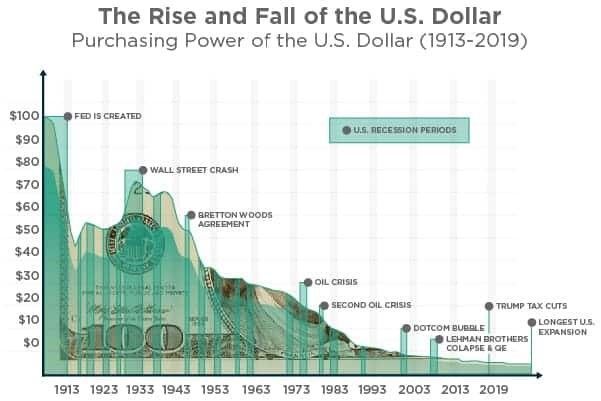
Under the Fed’s supervision, boom and bust cycles have continued. Three of them have been severe: the Great Depression, the stagflationary period of 1974-82, and the current “Great Recession.” Bank failures have occurred in alarmingly high numbers. Depending on what measurements are used, the dollar has lost between 95 and 98 percent of its purchasing power. (Amazingly, the Fed’s official position today is that inflation is not high enough, so the erosion of the dollar continues as a matter of policy.)
Having failed to achieve its original goals, the Fed also has had a miserable record in accomplishing later goals. The 1970 amendments to the Federal Reserve Act stipulated that the Fed should “promote effectively the goals of maximum employment, stable prices, and moderate long-term interest rates.” In baseball parlance, the Fed has been “0-for-three.”
First, the premise that the central bank can “fix” unemployment is erroneous. It is based on the Phillips curve—the discredited academic theory positing a trade-off between inflation and employment. Unemployment is fundamentally a price problem, not a monetary problem; therefore, the cure for unemployment is a free market in wages, not any particular monetary policy. The Fed’s current policy of persisting in “quantitative easing” until the official unemployment rate reaches a targeted level is the wrong medicine.
Second, central bank tampering with interest rates is the fundamental cause of, not the cure for, the boom and bust cycles; thus, the Fed should cease from tampering with interest rates.
Finally, focusing on “stable prices” is looking at the problem backwards. The Fed shouldn’t try to influence prices any more than a nurse should influence the readings of a thermometer. The “fever” that causes prices to rise and purchasing power to fall is sick money. “Heal” the money (i.e., do away with a fiat currency and abolish fractional reserve banking) and prices will take care of themselves.
Politically, the Fed is repugnant to the American system. Its chairman is commonly referred to as the second most powerful person in the country. In a democratic republic, should the second most powerful policymaker be unelected?
The Fed is unaccountable. Former congressman and presidential candidate Ron Paul tried to get Congress to mandate an audit of the Fed for years, but a majority of his colleagues seem afraid to take this simple, prudent step. Here, let me share an experience I had in 1981: A young congressman (later the governor of his state) gave a talk in which he asserted that Congress essentially was helpless because of the Fed’s enormous power. Afterward, I approached him and said that the creator is superior to the creation, and that since the Fed was created by an act of Congress, it could be reformed or abolished by an act of Congress. The congressman turned ashen and fell silent. You can decide for yourself whether congressmen are afraid of the Fed or are using the Fed to get themselves off the hook, but unless something changes, Congress will allow the Fed to remain unaccountable.
The Fed is unconstitutional. Thomas Jefferson argued that Congress has no authority to create a bank and give it a monopoly over our money, because such actions “are not among the powers specially enumerated” in the Constitution. I agree. The Constitution plainly designates the people’s elected representatives as the guardians of their money (“Congress shall have Power…To coin Money, [and] regulate the value thereof…”—Article I, Section 8.)
The Fed is a rogue entity. The Fed has arrogated to itself arbitrary powers to create however much money it wants and buy whatever financial assets—whether government, private, or even foreign—it chooses. The Fed even keeps its own Inspector General in the dark.
It is anomalous that there should be such a powerful, unrestrained institution as the Fed in our body politic. The Fed’s centennial is nothing to celebrate. Instead, this institution of awesome, arbitrary powers makes a mockery of constitutional checks and balances. It poses a threat, not just to our currency and economic well-being, but to liberty itself. It’s a tragedy that this institution has lasted as long as it has.
Below are excerpts from Wikipedia, https://en.wikipedia.org/wiki/Criticism_of_the_Federal_Reserve.
Creation
Main article: History of the Federal Reserve System
An early version of the Federal Reserve Act was drafted in 1910 on Jekyll Island, Georgia, by Republican Senator Nelson Aldrich, chairman of the National Monetary Commission, and several Wall Street bankers. The final version, with provisions intended to improve public oversight and weaken the influence of the New York banking establishment, was drafted by Democratic Congressman Carter Glass of Virginia.[3] The structure of the Fed was a compromise between the desire of the bankers for a central bank under their control and the desire of President Woodrow Wilson to create a decentralized structure under public control.[4] The Federal Reserve Act was approved by Congress and signed by President Wilson in December 1913.[4]
Inflation policy
In The Case Against the Fed, Murray Rothbard argued in 1994 that, although a supposed core function of the Federal Reserve is to maintain a low level of inflation, its policies (like those of other central banks) have actually aggravated inflation. This occurs when the Fed creates too much fiat money backed by nothing. He called the Fed policy of money creation "legalized counterfeiting" and favored a return to the gold standard.[5] He wrote:
[I]t is undeniable that, ever since the Fed was visited upon us in 1914, our inflations have been more intense, and our depressions far deeper, than ever before. There is only one way to eliminate chronic inflation, as well as the booms and busts brought by that system of inflationary credit: and that is to eliminate the counterfeiting that constitutes and creates that inflation. And the only way to do that is to abolish legalized counterfeiting: that is, to abolish the Federal Reserve System, and return to the gold standard, to a monetary system where a market-produced metal, such as gold, serves as the standard money, and not paper tickets printed by the Federal Reserve.[6]
The Federal Reserve has been criticized as not meeting its goals of greater stability and low inflation.[7] This has led to a number of proposed changes including advocacy of different policy rules[8] or dramatic restructuring of the system itself.[9]
Milton Friedman concluded that governments do have a role in the monetary system,[10] he was critical of the Federal Reserve due to its poor performance and felt it should be abolished.[11][12] Friedman believed that the Federal Reserve System should ultimately be replaced with a computer program.[9] He favored a system that would automatically buy and sell securities in response to changes in the money supply.[13] This proposal has become known as Friedman's k-percent rule.[14]
Others have proposed NGDP targeting as an alternative rule to guide and improve central bank policy.[15][16] Prominent supporters include Scott Sumner,[17] David Beckworth,[18] and Tyler Cowen.[19]
Congress
Several members of Congress have criticized the Fed. Senator Robert Owen, whose name was on the Glass-Owen Federal Reserve Act, believed that the Fed was not performing as promised. He said:
The Federal Reserve Board was created to control, regulate and stabilize credit in the interest of all people. . . . The Federal Reserve Board is the most gigantic financial power in all the world. Instead of using this great power as the Federal Reserve Act intended that it should, the board . . . delegated this power to the banks.[20][21]
Representative Louis T. McFadden, Chairman of the House Committee on Banking and Currency from 1920 to 1931, accused the Federal Reserve of deliberately causing the Great Depression. In several speeches made shortly after he lost the chairmanship of the committee, McFadden claimed that the Federal Reserve was run by Wall Street banks and their affiliated European banking houses. In one 1932 House speech (that has been criticized as bluster[22]), he stated:
Mr. Chairman, we have in this country one of the most corrupt Institutions the world has ever known. I refer to the Federal Reserve Board and the Federal Reserve banks; . . . This evil institution has impoverished and ruined the people of the United States . . . through the corrupt practices of the moneyed vultures who control it.[23]
Many members of Congress who have been involved in the House and Senate Banking and Currency Committees have been open critics of the Federal Reserve, including Chairmen Wright Patman,[24] Henry Reuss,[25] and Henry B. Gonzalez. Representative Ron Paul, Chairman of the Monetary Policy Subcommittee in 2011, is known as a staunch opponent of the Federal Reserve System.[26] He routinely introduced bills to abolish the Federal Reserve System,[27] three of which gained approval in the House but lost in the Senate.[28]
Congressman Paul also introduced H.R. 459: Federal Reserve Transparency Act of 2011,[29][30] This act required an audit of the Federal Reserve Board and the twelve regional banks, with particular attention to the valuation of its securities. His son, Senator Rand Paul, has introduced similar legislation in subsequent sessions of Congress.[31]
Great Depression (1929)
Money supply decreased significantly between Black Tuesday and the Bank Holiday in March 1933 when there were massive bank runs across the United States
Main article: Causes of the Great Depression
Milton Friedman and Anna Schwartz stated that the Fed pursued an erroneously restrictive monetary policy, exacerbating the Great Depression. After the stock market crash in 1929, the Fed continued its contraction (decrease) of the money supply and refused to save banks that were struggling with bank runs. This mistake, critics charge, allowed what might have been a relatively mild recession to explode into catastrophe. Friedman and Schwartz believed that the depression was "a tragic testimonial to the importance of monetary forces."[32] Before the establishment of the Federal Reserve, the banking system had dealt with periodic crises (such as in the Panic of 1907) by suspending the convertibility of deposits into currency. In 1907, the system nearly collapsed and there was an extraordinary intervention by an ad-hoc coalition assembled by J. P. Morgan. In the years 1910–1913, the bankers demanded a central bank to address this structural weakness. Friedman suggested that a similar intervention should have been followed during the banking panic at the end of 1930. This might have stopped the vicious circle of forced liquidation of assets at depressed prices, just as suspension of convertibility in 1893 and 1907 had quickly ended the liquidity crises at the time.[33]
Essentially, in the monetarist view, the Great Depression was caused by the fall of the money supply. Friedman and Schwartz note that "[f]rom the cyclical peak in August 1929 to a cyclical trough in March 1933, the stock of money fell by over a third."[34] The result was what Friedman calls "The Great Contraction"—a period of falling income, prices, and employment caused by the choking effects of a restricted money supply. The mechanism suggested by Friedman and Schwartz was that people wanted to hold more money than the Federal Reserve was supplying. People thus hoarded money by consuming less. This, in turn, caused a contraction in employment and production, since prices were not flexible enough to immediately fall. Friedman and Schwartz argued the Federal Reserve allowed the money supply to plummet because of ineptitude and poor leadership.[35]
Many have since agreed with this theory, including Ben Bernanke, Chairman of the Federal Reserve from 2006 until 2014, who, in a speech honoring Friedman and Schwartz, said:
Let me end my talk by abusing slightly my status as an official representative of the Federal Reserve. I would like to say to Milton and Anna: Regarding the Great Depression, you're right. We did it. We're very sorry. But thanks to you, we won't do it again.[36][37]
Friedman has said that ideally he would prefer to "abolish the Federal Reserve and replace it with a computer."[38] He preferred a system that would increase the money supply at some fixed rate, and he thought that "leaving monetary and banking arrangements to the market would have produced a more satisfactory outcome than was actually achieved through government involvement".[39]
In contrast to Friedman's argument that the Fed did too little to ease after the crisis, Murray Rothbard argued that the crisis was caused by the Fed being too loose in the 1920s in the book America's Great Depression.
2008 financial crisis
Main article: 2008 financial crisis
Some economists, such as John B. Taylor,[40] have asserted that the Fed was responsible, at least partially, for the United States housing bubble which occurred prior to the 2007 recession. They claim that the Fed kept interest rates too low following the 2001 recession.[41] The housing bubble then led to the credit crunch. Then-Chairman Alan Greenspan disputes this interpretation. He points out that the Fed's control over the long-term interest rates (to which critics refer) is only indirect. The Fed did raise the short-term interest rate over which it has control (i.e., the federal funds rate), but the long-term interest rate (which usually follows the former) did not increase.[42][43]
The Federal Reserve's role as a supervisor and regulator has been criticized as being ineffective. Former U.S. Senator Chris Dodd, then-chairman of the United States Senate Committee on Banking, Housing, and Urban Affairs, remarked about the Fed's role in the 2007-2008 economic crisis, "We saw over the last number of years when they took on consumer protection responsibilities and the regulation of bank holding companies, it was an abysmal failure."
Fractional reserve banking
Main articles: Fractional-reserve banking and Austrian business cycle theory
The Federal Reserve does not actually control the money supply directly and has delegated this authority to banks. If a bank has a reserve requirement of 10% and they have 10 million dollars in bank deposits, they can create 100 million dollars to loan out to borrowers, or make other investments if it is an investment bank. It is essentially going on margin 10:1 without having to pay interest on the margin, because it is in effect money that they created themselves. According to this critique, this is the primary cause of credit cycles or business cycles, because money supply creation is not under any single entity's control and is decentralized among many banks that are trying to maximize profits individually.[citation needed] The Federal Reserve indirectly controls this process by manipulating the Federal Funds Rate that sets the tone for interest rates on new debt throughout the economy, and intentionally puts the economy into a recession (hard landing) or slow the economy without a recession (soft landing) to tame inflation.[44]
Republican and Tea Party criticism
During several recent elections,[when?] the Tea Party movement has made the Federal Reserve a major point of attack, which has been picked up by Republican candidates across the country. Former Congressman Ron Paul (R) of Texas and his son Senator Rand Paul (R) of Kentucky have long attacked the Fed, arguing that it is hurting the economy by devaluing the dollar. They argue that its monetary policies cause booms and busts when the Fed creates too much or too little fiat money. Ron Paul's book End the Fed repeatedly points out that the Fed engages in money creation "out of thin air."[45] He argued that interest rates should be set by market forces, not by the Federal Reserve.[46] Paul argues that the booms, bubbles and busts of the business cycle are caused by the Federal Reserve's actions.[47]
In the book, Paul argues that "the government and its banking cartel have together stolen $0.95 of every dollar as they have pursued a relentlessly inflationary policy." David Andolfatto of the Federal Reserve Bank of St. Louis said the statement was "just plain false" and "stupid" while noting that legitimate arguments can be made against the Federal Reserve.[48] University of Oregon economist Mark Thoma described it as an "absurd" statement which data does not support.[49]
Surveys of economists show overwhelming opposition to abolishing the Federal Reserve or undermining its independence.[50][51] According to Princeton University economist Alan S. Blinder, "mountains of empirical evidence support the proposition that greater central bank independence produces not only less inflation but superior macroeconomic performance, e.g., lower and less volatile inflation with no more volatility in output."[51]
Ron Paul's criticism has stemmed from the influence of the Austrian School of Economics.[52] More specifically, economist Murray Rothbard was a vital figure in developing his views. Rothbard attempted to intertwine both political and economic arguments together in order to make a case to abolish the Federal Reserve. When first laying out his critiques, he writes "The Federal Reserve System is accountable to no one; it has no budget; it is subject to no audit; and no Congressional committee knows of...its operations."[53] This argument from Rothbard is outdated, however, as the Federal Reserve presently does report its balance sheet weekly as well as get audited by outside third parties.[54]
Rothbard also heavily critiques the Federal Reserve being independent from politics despite the Federal Reserve being given both private and public qualities.[54] The acknowledgment of the Federal Reserve being a part of government that exists outside of politics inevitably becomes a "self-perpetuating oligarchy, accountable to no one."[53] This ignores the fact that the Federal Reserve Board of Governors is a federal agency, appointed by the president and Senate.
Money supply should be controlled by Congress
In the 1930s, American Catholic priest Charles Coughlin called on Congress to take back control of the money supply, as it is given authority under Article I, Section 8, in the Enumerated Powers, to coin money and regulate the value thereof.[55]
"There is written in the Constitution of the United States that Congress has the right to coin, issue, and regulate the value of money."
— Father Charles Coughlin
Private ownership or control
According to the Congressional Research Service:
Because the regional Federal Reserve Banks are privately owned, and most of their directors are chosen by their stockholders, it is common to hear assertions that control of the Fed is in the hands of an elite. In particular, it has been rumored that control is in the hands of a very few people holding "class A stock" in the Fed.
As explained, there is no stock in the system, only in each regional Bank. More important, individuals do not own stock in Federal Reserve Banks. The stock is held only by banks who are members of the system. Each bank holds stock proportionate to its capital. Ownership and membership are synonymous. Moreover, there is no such thing as "class A" stock. All stock is the same.
This stock, furthermore, does not carry with it the normal rights and privileges of ownership. Most significantly, member banks, in voting for the directors of the Federal Reserve Banks of which they are a member, do not get voting rights in proportion to the stock they hold. Instead, each member bank regardless of size gets one vote. Concentration of ownership of Federal Reserve Bank stock, therefore, is irrelevant to the issue of control of the system (italics in original).[56]
According to the web site for the Federal Reserve System, the individual Federal Reserve Banks "are the operating arms of the central banking system, and they combine both public and private elements in their makeup and organization."[57] Each of the 12 Banks has a nine-member board of directors: three elected by the commercial banks in the Bank's region, and six chosen – three each by the member banks and the Board of Governors – "to represent the public with due consideration to the interests of agriculture, commerce, industry, services, labor and consumers."[58] These regional banks are in turn controlled by the Federal Reserve Board of Governors, whose seven members are nominated by the president of the United States and confirmed by the Senate.[59]
Member banks ("about 38 percent of the nation's more than 8,000 banks")[60] are required to own capital stock in their regional banks.[60][61] Until 2016, the regional banks paid a set 6% dividend on the member banks' paid-in capital stock (not the regional banks' profits) each year, returning the rest to the US Treasury Department.[62] As of February 24, 2016, member banks with more than $10 billion in assets receive an annual dividend on their paid-in capital stock (Reserve Bank stock) of the lesser of 6% percent and the highest yield of the 10-year Treasury note auctioned at the last auction held prior to the payment of the dividend. Member banks with $10 billion or less in assets continue to be paid a set 6% annual dividend. This change was implemented during the Obama administration in order "to implement the provisions of section 32203 of the Fixing America's Surface Transportation Act (FAST Act)".[63] The Fed has noted that this has created "some confusion about 'ownership'":
[Although] the Reserve Banks issue shares of stock to member banks...owning Reserve Bank stock is quite different from owning stock in a private company. The Reserve Banks are not operated for profit, and ownership of a certain amount of stock is, by law, a condition of membership in the System. The stock may not be sold, traded, or pledged as security for a loan….[64]
In his textbook, Monetary Policy and the Financial System, Paul M. Horvitz, the former Director of Research for the Federal Deposit Insurance Corporation, stated,
...the member banks can exert some rights of ownership by electing some members of the Board of Directors of the Federal Reserve Bank [applicable to those member banks]. For all practical purposes, however, member bank ownership of the Federal Reserve System is merely a fiction. The Federal Reserve Banks are not operated for the purpose of earning profits for their stockholders. The Federal Reserve System does earn a profit in the normal course of its operations, but these profits, above the 6% statutory dividend, do not belong to the member banks. All net earnings after expenses and dividends are paid to the Treasury.[65]
In the American Political Science Review, Michael D. Reagan[66] wrote,
...the "ownership" of the Reserve Banks by the commercial banks is symbolic; they do not exercise the proprietary control associated with the concept of ownership nor share, beyond the statutory dividend, in Reserve Bank "profits." ...Bank ownership and election at the base are therefore devoid of substantive significance, despite the superficial appearance of private bank control that the formal arrangement creates.[67][68]
Transparency issues
One critique is that the Federal Open Market Committee, which is part of the Federal Reserve System, lacks transparency and is not sufficiently audited.[69] A report by Bloomberg News asserts that the majority of Americans believes that the System should be held more accountable or that it should be abolished.[70] Another critique is the contention that the public should have a right to know what goes on in the Federal Open Market Committee (FOMC) meetings.[71][72][73]
See also:
· Black Friday (1869) Covers the gold scandal of 1869
· Causes of the Great Depression
· Criticism of the United States government#Criticism of agencies
References:
- ^ Weissert • •, Will (2012-01-18). "The Gold Standard: Ron Paul Gives New Life to an Old Issue". NBC 5 Dallas-Fort Worth. Retrieved 2024-02-23.
- ^ Taylor, John B. "Taylor: Federal Reserve Monetary and the Financial Crisis: A Reply to Chairman Ben Bernanke". WSJ. Retrieved 2024-02-23.
- ^ Wicker, Elmus (2005). The Great Debate On Banking Reform - Nelson Aldrich And The Origins Of The Fed. Ohio State University Press. pp. 4–6. ISBN 9780814210000.
- ^ Jump up to:a b Johnson, Roger T. (February 2010). "Historical Beginnings... The Federal Reserve" (PDF). Federal Reserve Bank of Boston. Archived from the original (PDF) on 25 December 2010. Retrieved 30 December 2014.
- ^ Murray Rothbard (2007). The Case Against the Fed. Ludwig Von Mises Institute. pp. 27–29, 146. ISBN 978-0945466178.
- ^ Murray Rothbard (2007). The Case Against the Fed. Ludwig Von Mises Institute. p. 146. ISBN 978-0945466178.
- ^ Selgin, George; Lastrapes, William D. (2012). "Has the Fed been a failure?". Journal of Macroeconomics. 34 (3): 569–596. doi:10.1016/j.jmacro.2012.02.003.
- ^ Salter, Alexander (2014-11-21). "An Introduction to Monetary Policy Rules". Mercatus Center. Archived from the original on 2019-03-01. Retrieved 2019-03-01.
- ^ Jump up to:a b "Mr. Market". Hoover Institution. January 30, 1999. Archived from the original on September 23, 2018. Retrieved September 22, 2018.
- ^ Friedman, Milton; Schwartz, Anna J. (1986). "Has government any role in money?" (PDF). Journal of Monetary Economics. 17 (1): 37–62. doi:10.1016/0304-3932(86)90005-X. Archived (PDF) from the original on 2020-09-04. Retrieved 2020-08-30.
- ^ Milton Friedman – Abolish The Fed. Archived from the original (YouTube) on June 11, 2015. I have long been in favor of abolishing it.
- ^ "My first preference would be to abolish the Federal Reserve" on YouTube
- ^ Friedman, M. (1996). The Counter-Revolution in Monetary Theory. In Explorations in Economic Liberalism (pp. 3-21). Palgrave Macmillan, London. "It is precisely this leeway, this looseness in the relation, this lack of a mechanical one-to-one correspondence between changes in money and in income that is the primary reason why I have long favored for the USA a quasi-automatic monetary policy under which the quantity of money would grow at a steady rate of 4 or 5 per cent per year, month-in, month-out."
- ^ Salter, A. W. (2014). An Introduction to Monetary Policy Rules. Mercatus Workıng Paper. George Mason University.
- ^ Sheedy, Kevin D. (2014). "Debt and incomplete financial markets: a case for nominal GDP targeting" (PDF). Brookings Papers on Economic Activity. 45 (1): 301–373. doi:10.1353/eca.2014.0005. S2CID 7642472. Archived (PDF) from the original on 2020-10-08. Retrieved 2020-06-01.
- ^ Benchimol, Jonathan; Fourçans, André (2019). "Central bank losses and monetary policy rules: a DSGE investigation". International Review of Economics & Finance. 61 (1): 289–303. doi:10.1016/j.iref.2019.01.010. S2CID 159290669.
- ^ Sumner, Scott (2012). "The case for nominal GDP targeting". Mercatus Research. doi:10.2139/ssrn.3255027. S2CID 219385932.
- ^ Beckworth, David; Hendrickson, Joshua (2020). "Nominal GDP targeting and the Taylor rule on an even playing field". Journal of Money, Credit and Banking. 52 (1): 269–286. doi:10.1111/jmcb.12602. S2CID 197772130.
- ^ Cowen, Tyler (2016-08-23). "Why nominal GDP targeting is an especially good idea right now". Marginal Revolution. Archived from the original on 2019-03-01. Retrieved 2019-03-01.
- ^ Mullins, Eustace (2009). The Secrets of the Federal Reserve. Bridger House Publishers. ISBN 978-0-9656492-1-6. Archived from the original on 2005-11-26. Retrieved 2014-12-30.
- ^ "Owen criticises reserve board" Archived 2018-10-19 at the Wayback Machine, The New York Times (July 25, 1921)
- ^ Flaherty, Edward (6 Sep 2000). "Myth #10. The Legendary Tirade of Louis T. McFadden". Political Research Associates. Archived from the original on 2 October 2006. Retrieved 30 December 2014.
- ^ McFadden, Louis (June 10, 1932). Congressional Record, June 10, 1932, Louis T. McFadden.
- ^ "Banking: Fight over the Federal Reserve". Time. 14 February 1964. Archived from the original on December 9, 2010. Retrieved 20 August 2010.
- ^ Uchitelle, Louis (24 August 1989). "Moves On in Congress to Lift Secrecy at the Federal Reserve". The New York Times. Archived from the original on 30 May 2013. Retrieved 20 August 2010.
- ^ Ron Paul (2009). End the Fed. Grand Central Publishing. ISBN 9780446568180. The Fed was the cause of the Depression.
- ^ E.g., H.R. 2755 (110th Congress); H.R. 2778 (108th Congress); H.R. 5356 (107th Congress); H.R. 1148 (106th Congress)
- ^ "H.R. 2755: Federal Reserve Board Abolition Act". GovTrack.us. 15 June 2007. Archived from the original on 1 January 2010. Retrieved 24 June 2009.
- ^ "H.R. 459: Federal Reserve Transparency Act of 2011". GovTrack.us. 26 January 2011. Archived from the original on 23 July 2012. Retrieved 18 July 2012.
- ^ Jennifer Bendery (26 July 2012). "Nancy Pelosi: 'Audit The Fed' Bill Is Likely Going Nowhere". HuffPost. Archived from the original on 29 July 2012. Retrieved 27 July 2012.
- ^ Stiles, Megan (December 18, 2015). "Senate Vote on Audit the Fed Scheduled for January 12th". Campaign for Liberty. Archived from the original on December 23, 2015. Retrieved December 23, 2015.
- ^ Milton Friedman; Anna Jacobson Schwartz (2008). The Great Contraction, 1929–1933 (New ed.). Princeton University Press. pp. xviii, 13. ISBN 978-0691137940.
- ^ Milton Friedman; Anna Schwartz (2008). The Great Contraction, 1929–1933 (New ed.). Princeton University Press. p. 28. ISBN 978-0691137940.
- ^ Milton Friedman; Anna Schwartz (2008). The Great Contraction, 1929–1933 (New ed.). Princeton University Press. p. 11. ISBN 978-0691137940.
- ^ Chang-Tai Hsie; Christina D. Romer (2006). "Was the Federal Reserve Constrained by the Gold Standard During the Great Depression?" (PDF). Journal of Economic History. Archived (PDF) from the original on 2016-02-22. Retrieved 2015-12-23.
- ^ Bernanke, Ben S. (8 Nov 2002). "Remarks by Governor Ben S. Bernanke". Federal Reserve. Archived from the original on 24 March 2020. Retrieved 1 Jan 2007.
- ^ Milton Friedman; Anna Jacobson Schwartz (2008). The Great Contraction, 1929–1933 (New ed.). Princeton University Press. p. 247. ISBN 978-0691137940. Archived from the original on 2020-01-16. Retrieved 2018-09-19.
- ^ O'Toole, Kathleen (9 September 1997). "Greenspan voices concerns about quality of economic statistics". Stanford News Service. Archived from the original on 14 February 2009. Retrieved 24 June 2009.
- ^ Ebeling, Richard M. (1 March 1999). "Monetary Central Planning and the State, Part 27: Milton Friedman's Second Thoughts on the Costs of Paper Money". fff.org. Archived from the original on 21 October 2014. Retrieved 30 December 2014.
- ^ Taylor, John B. (10 January 2010). "The Fed and the Crisis: A Reply to Ben Bernanke". The Wall Street Journal. Archived from the original on 27 January 2015. Retrieved 19 November 2012.
- ^ Henderson, David (27 March 2009). "Did the Fed Cause the Housing Bubble?". The Wall Street Journal. Archived from the original on 4 October 2019. Retrieved 3 August 2017.
- ^ Jim Lehrer (September 18, 2007). Greenspan Examines Federal Reserve, Mortgage Crunch. PBS Newshour. Alan Greenspan. NewsHour Productions LLC. Archived from the original on August 31, 2017. Retrieved August 26, 2017.
- ^ Labonte, Marc; Makinen, Gail E. (19 March 2008). "Federal Reserve Interest Rate Changes: 2000-2008" (PDF). assets.opencrs.com. Archived from the original (PDF) on 30 December 2014.
- ^ "Here We Go Again: The Fed is Causing Another Recession". 21 June 2022. Archived from the original on 4 July 2022. Retrieved 4 July 2022.
- ^ Ron Paul (2009). End the Fed. Grand Central Publishing. ISBN 9780446568180. out of thin air.
- ^ "A lonely voice against the Fed now leads a chorus". The Washington Post. 2009. Archived from the original on 2019-01-05. Retrieved 2019-01-28.
- ^ "What Happens If We End the Fed?". U.S. News. 2011. Archived from the original on 2019-01-05. Retrieved 2019-01-04.
- ^ Andolfatto, David (2011-03-23). "Ron Paul's Money Illusion (Sequel)". MacroMania. Archived from the original on 2019-01-04. Retrieved 2019-01-04.
- ^ "Ron Paul's Money Illusion: The Sequel". Economist's View. Archived from the original on 2019-01-05. Retrieved 2019-01-04.
- ^ "Fed policy". igmchicago.org. Archived from the original on 2019-01-06. Retrieved 2019-01-04.
- ^ Jump up to:a b Blinder, Alan (2010). "How Central Should the Central Bank Be?" (PDF). Journal of Economic Literature. 48: 123–133. doi:10.1257/jel.48.1.123. Archived (PDF) from the original on 2017-08-13. Retrieved 2019-09-05.
- ^ Paul, Ron (2011). Mises and Austrian economics : a personal view. Terra Libertas. ISBN 978-1-908089-33-5. OCLC 822300912.
- ^ Jump up to:a b Rothbard, Murray (2007). The Case Against the Fed. Ludwig Von Mises Institute. ISBN 9780945466178.
- ^ Jump up to:a b "The Fed - Does the Federal Reserve ever get audited?". Board of Governors of the Federal Reserve System. Archived from the original on 2021-04-16. Retrieved 2021-04-20.
- ^ "Charles E. Coughlin". Archived from the original on 2018-08-10. Retrieved 2023-09-05.
- ^ Woodward, G. Thomas (31 July 1996). "Money and the Federal Reserve System: Myth and Reality". Report No. 96–672 E. Congressional Research Service, Library of Congress. OCLC 39127005. Archived from the original on 5 November 2008. Retrieved 30 December 2014.
- ^ The Federal Reserve System: Purposes and Functions (PDF) (9th ed.). Federal Reserve. June 2005. Archived (PDF) from the original on 21 February 2015. Retrieved 30 December 2014.
- ^ "What We Do". New York Fed. March 2010. Archived from the original on 31 December 2014. Retrieved 30 December 2014.
- ^ "Federal Reserve Board - Board Members". Board of Governors of the Federal Reserve System. Archived from the original on 18 March 2018. Retrieved 30 December 2020.
- ^ Jump up to:a b "Federal Reserve Bank Ownership". Factcheck.org. 31 March 2008. Archived from the original on 21 December 2014. Retrieved 30 December 2014.
- ^ "12 U.S.C. § 282 et seq". Cornell University Law School.
- ^ "12 U.S.C. § 289(a)(1)(A)". Cornell University Law School.
- ^ "Federal Reserve Board issues interim final rule regarding dividend payments on Reserve Bank capital stock". Board of Governors of the Federal Reserve System. 18 February 2016. Archived from the original on 25 November 2020. Retrieved 30 December 2020.
- ^ "Who owns the Federal Reserve?". Federal Reserve. Archived from the original on 25 March 2020. Retrieved 30 December 2014.
- ^ Horvitz, Paul M. (1974). Monetary Policy and the Financial System (3rd ed.). Prentice Hall. p. 293. ISBN 9780135998861.
- ^ Not to be confused with Michael Edward Reagan, the son of President Ronald Reagan.
- ^ Reagan, Michael D. (March 1961). "The Political Structure of the Federal Reserve System". American Political Science Review. 55 (1): 64–76. doi:10.2307/1976050. JSTOR 1976050. S2CID 147189298.
- ^ Mittra, S. (1970). Money and Banking: Theory, Analysis, and Policy. New York: Random House. p. 153.
- ^ Poole, William (July 2002). "Untold story of FOMC: Secrecy is exaggerated". St. Louis Federal Reserve. Archived from the original on 2008-12-28. Retrieved 2009-06-24.
- ^ Zumbrun, Joshua (9 December 2010). "Majority of Americans Say Fed Should Be Reined In or Abolished, Poll Shows". Bloomberg L.P. Archived from the original on 2015-01-27. Retrieved 2017-03-06.
- ^ Poole, William (6 October 2004). "FOMC Transparency" (PDF). Federal Reserve Bank of St. Louis Review. 87. Federal Reserve Bank of St. Louis: 1–9. Archived (PDF) from the original on 30 December 2014. Retrieved 30 December 2014.
- ^ "Remarks by Chairman Alan Greenspan - Transparency in monetary policy". Federal Reserve. 11 October 2001. Archived from the original on 11 May 2009. Retrieved 24 June 2009.
- ^ "Remarks by Vice Chairman Roger W. Ferguson, Jr.—Transparency in Central Banking: Rationale and Recent Developments". Federal Reserve. 19 April 2001. Archived from the original on 11 May 2009. Retrieved 24 June 2009.