The Whitewashing of Your Tax Dollars
Pattern and Practice
By Mitchell Vexler, March 2, 2026
Link to download this article in pdf, including hyperlinks
The Report by Mackenzie Eason can only be viewed as a whitewash, because the report is inconsistent and wrong, as the writers could not have looked at the requirements or math of USPAP, did not examine the software override allowing manipulation of values (whether a new software system or old one), and would take 3 cross examination questions to completely prove the whitewashing.
This is the Scope of Work from which the ability to help determine the layers of fraud can be recognized and dealt with.
Attached hereto, JCAD and GISD Partial List of Violations, is the truth of what is behind the Mackenzie Eason report’s findings described in the Executive Summary section found on page 3 through 5.
Below are excerpts from page 4 of report:
Material Gaps and Risks
Mass appraisal practices rely heavily on outdated schedules, manual adjustments, and legacy workarounds that undermine uniformity and defensibility.
Comment: The words “manual adjustments” and “workarounds” have been used by the Denton Central Appraisal District themselves, to describe practices and tasks performed. They are on record stating they manipulated data: removed data, altered it, and re-loaded it into their software system. They are on record saying they often do workarounds because the software is not completing the task they need to get done, i.e. it is not yielding the result they want. Additionally, they said that they correspond with other appraisal districts, such as Bexar, and share how to do these “workarounds”.
The absence of income-based valuation models for commercial property represents a significant methodological gap.
Organizational culture has been strained by inconsistent and poor leadership, poor communication, and a lack of accountability, contributing to turnover exceeding 100 percent over three years.
Policies, procedures, and internal controls were largely absent at the outset of the review, exposing the district to operational and compliance risk.
Technology modernization efforts, particularly the stalled GSA CAMA conversion, are constrained by the absence of leadership, lack of internal IT capacity, and unclear project ownership.
Comment: IT and software conversion issues exist/existed at the Denton Central Appraisal District also. Delays in CAMA software conversion, followed by a reversion back to prior software, along with other events, led to concerns over the reliability of the data used to issue the appraisal values & appraisal notices in 2021. Then in July 2021, the tax roll was falsified, i.e. fraudulently certified.
Governance and ARB oversight weaknesses have eroded stakeholder confidence and increased reputational risk.
Comment: The stakeholders are the taxing entities that the CAD represents and for whom the CAD produces appraisal values and issues appraisal notices. Communication to and from the CAD and the taxing entities needs to happen so they can “cook the books” together, agree on appraisal values to be set to cover tax revenue they’d like to collect. Stakeholders are likely to be upset with the CAD if the appraisal values do not support, or result in, the dollar value of tax revenue needed.
Compliance Outcomes
JCAD is largely compliant with USPAP Standards 5 and 6 and applicable provisions of the Texas Property Code.
Comment: What does “largely” compliant mean, more than 51% compliant, 75% compliant, 95% compliant? Anything less than 100% compliant means the mass appraisal valuation data and results have been corrupted, which in turn infects and affects the entire database of valuations. Each time an improper valuation is used to compare and value another property, another valuation is improperly made, corrupted.
Compliance risks exist where documentation, training, income modeling, internal controls, and ARB procedures fall short of best practice and, in some cases, statutory expectations.
Comment: The Mackenzie Eason report was quite generous by saying compliance risks exist “in some cases” with statutory expectations. In light of the number other items the report has documented in the findings and recommendations of each domain (area) evaluated, it is clear that JCAD has FAILED the statutory expectations, that is, they have violated appraisal law and property tax code.
Brushing past the most critical issues does nothing to fix the problems because the Mackenzie Eason report failed to quantify the issues and those responsible. Further, multiple pages were scrubbed (redacted) from the report. Why is that? It is property tax dollars that were used to pay for the report, and the public is 100% entitled to understand the fraud that is being perpetrated upon them.
No one can fix what they can’t define and quantify. The JCAD and GISD Partial List of Violations is what the report failed to identify. It is the culmination of what was touched upon within the Executive Summary on pages 3 through 5.
To get a better understanding of the Mackenzie Eason Report’s findings, one has to read beyond the Executive Summary, aka whitewash summary. Read all of the findings included, from the Organizational Overview section and in each of the Domain Valuation sections, 4.1 to 4.12. The problems and violations are greater than they are described in The Executive Summary.
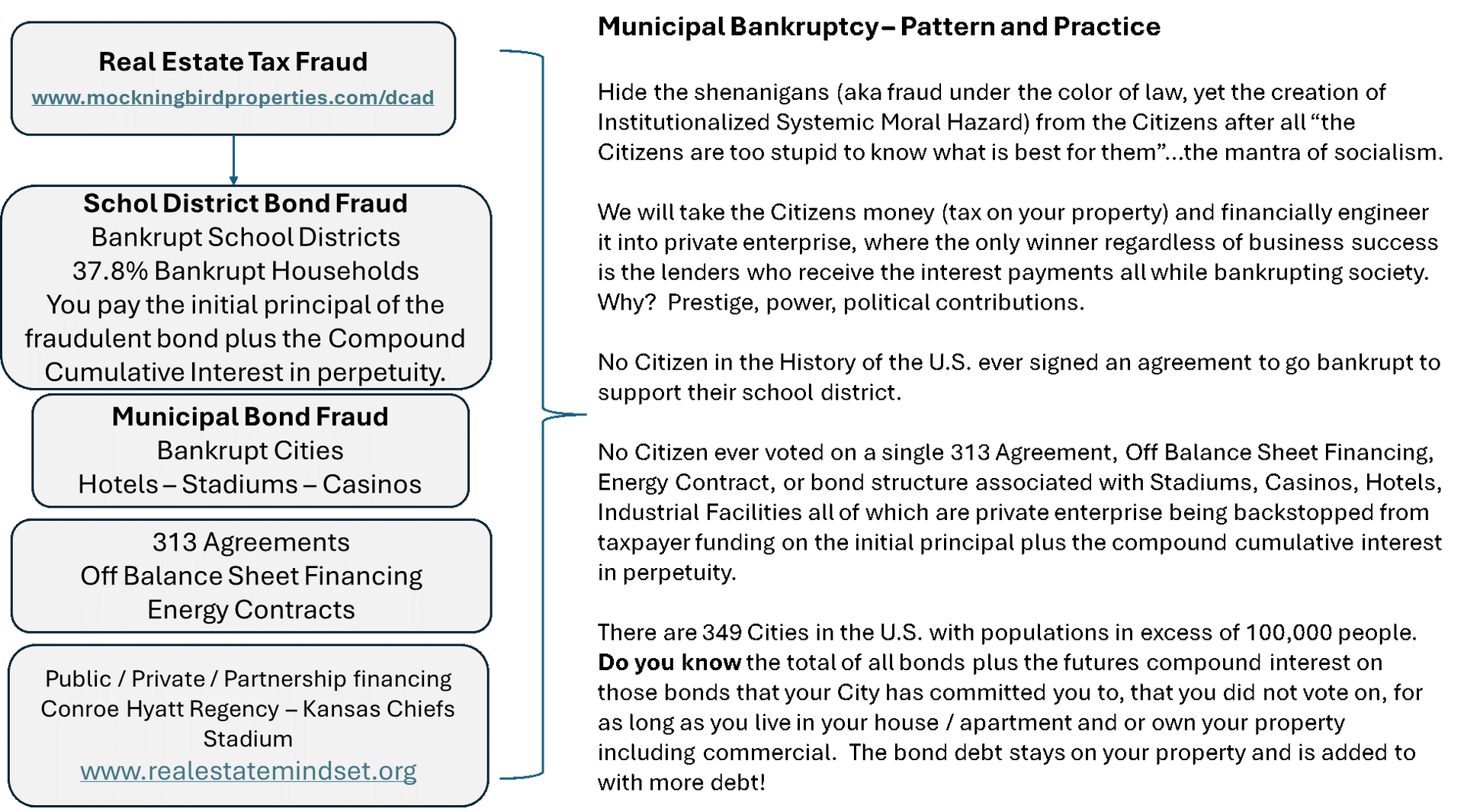
For further examples of a CAD's pattern & practices to defraud, see the Hope McClure Deposition Transcript and our summary notes from the DCAD’s IAAO Gap Analysis Report, along with other evidence posted to https://www.mockingbirdproperties.com/dcad.