



Sunk-Cost Entrenchment: Why Institutions Defend Failing Systems
By Mitchell Vexler, September 30, 2026
link to download pdf of article
While having a discussion with Daniela Cambone (link) we spoke about the main-stream media going against the best interests of their viewers. As is often the case, certain conversations replay in my mind because they lead to other ideas or unresolved questions.
One of those questions is why do those people, such as the Chief Appraisers, School Superintendents, Employees, Board Members, Attorneys not defending the institutions but actively participating in aiding and abetting, government agencies running cover for the CADs and school districts, and those who falsify the methods of advertising demand that the school districts raise more money even though the vast majority of the money is not going to any child. It is being used to cover off a portion of the interest while roughly an additional 11% is needed as an injection by the Federal government to cover off what the local property owners don’t have, being the resources to pay. These people are clearly guilty of crimes and continue to repeat the same crimes even after they are given proof of their actions and then judges refuse to allow adjudication of the black letter of the law?
Understanding why the bond underwriters do what they do is easy because that is simply about a fee generation machine. They tell investors, “we have unlimited tax” to supply you the investor a rate of return, and the underwriters and associated attorneys get fees. They underwrite the bonds, they sell the bonds, they get a fee. The bonds need to be re-sold from time to time. They get a fee. Easy! One could say that the Superintendent and Chief Appraisers are paid abnormally high salaries, in addition to pensions, so perhaps they are being paid / bought off to look the other way. Perhaps.
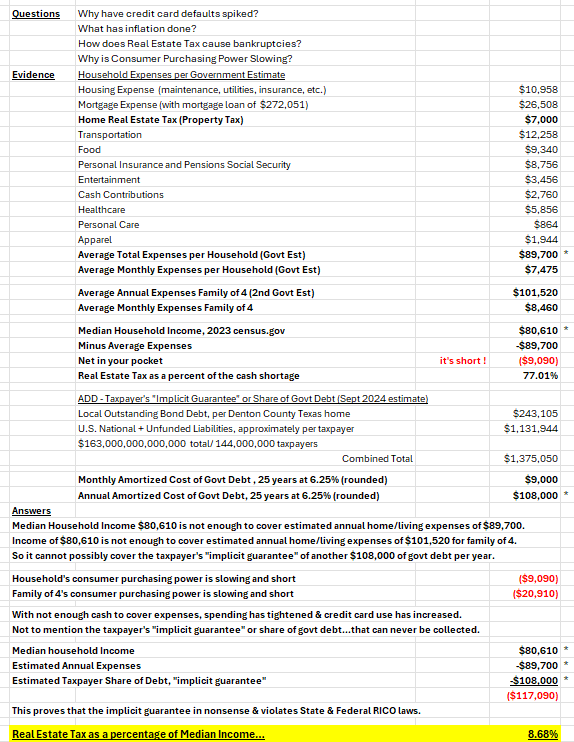
Chief Appraiser recruitment and compensation structure is based on the Chief Appraiser pushing values to generate more money, which is what the Boards hire the CA to do, and we know this because property values have gone up roughly 100% in the last 6 years based on overvaluation and over taxation which we have shown is fraud. The question is whether recruitment, retention, budget incentives, performance expectations, or institutional pressure create indirect incentives to defend increasing valuations despite the statutory prohibition against value-linked compensation? A pyramid scheme does not fit the description of the personal issues. A Ponzi scheme that uses money from new investors to pay earlier investors while misrepresenting the source of the returns (or in this case, the payoff of the debt) is extraordinarily close to Ponzi scheme but also involving other government entities involved including the Federal Reserve.
Public pensions can create a different but related concern. Defined-benefit public pensions are generally financed from employee contributions, employer contributions, and investment earnings; when contributions are inadequate, unfunded liabilities can shift costs into the future. GAO has specifically noted that inadequate contributions can transfer costs and risks to later taxpayers and governments that can produce an intergenerational dependency, but this is not itself a pyramid scheme.
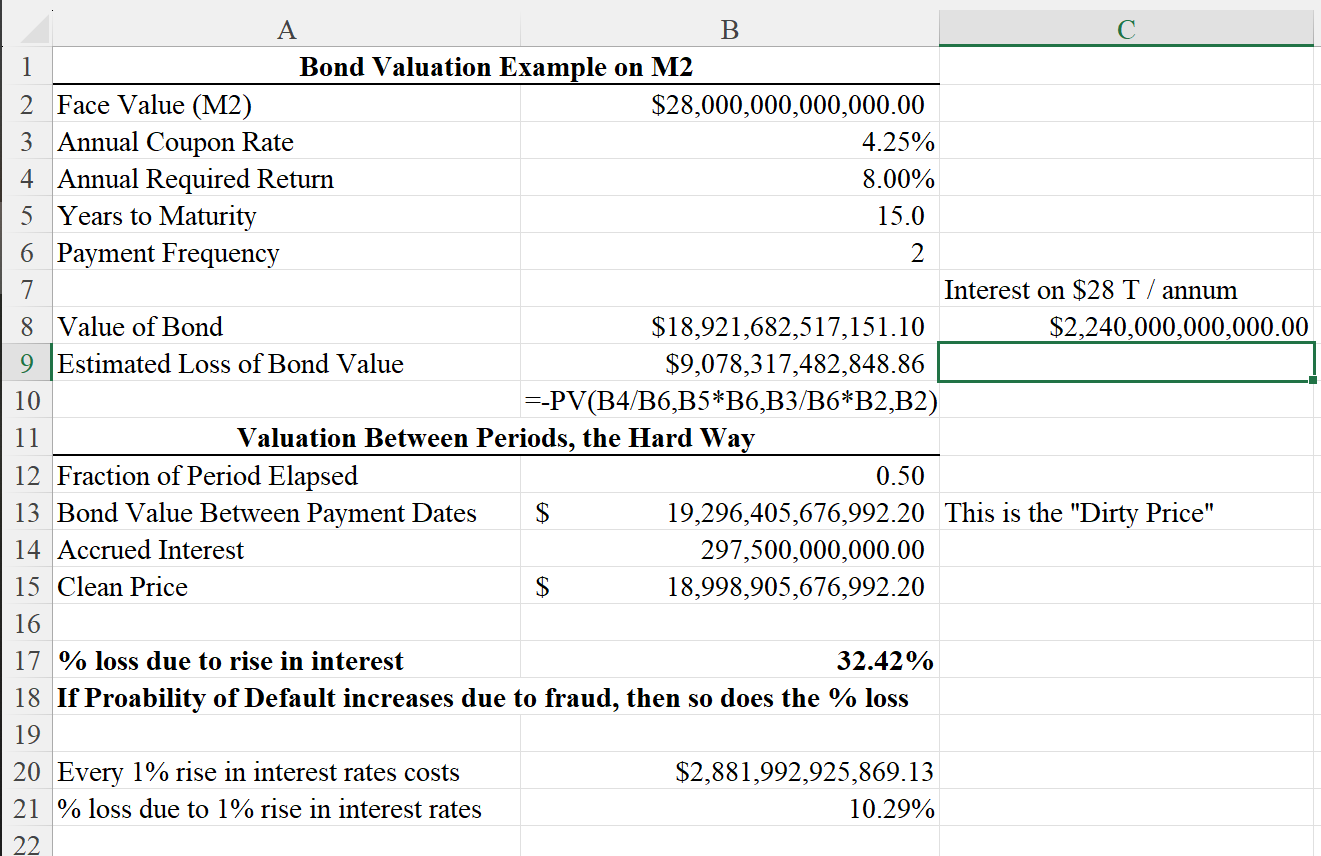
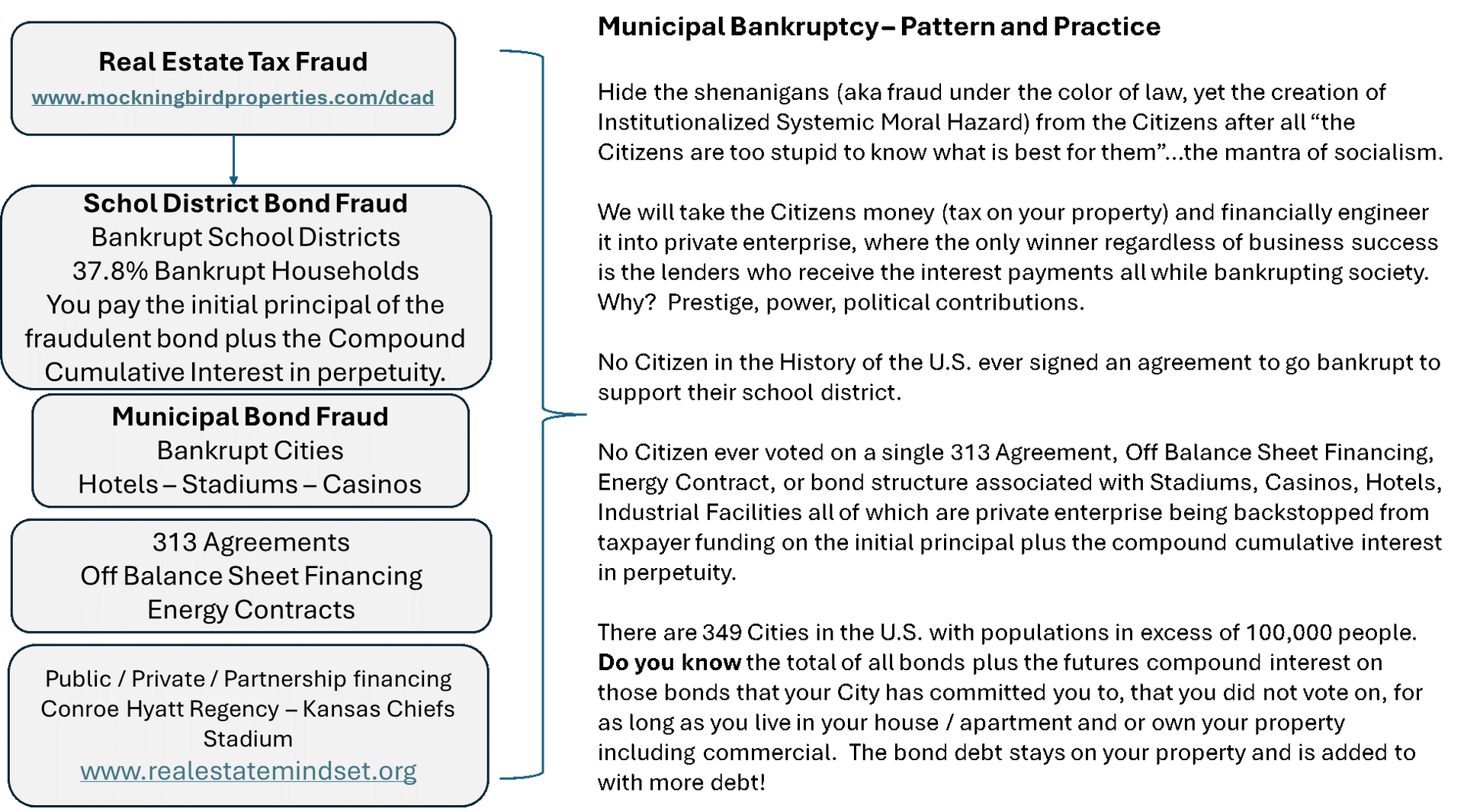
Similarly, municipal bonds are on their face legitimate debt instruments in which the issuer promises interest and eventual repayment of principal. The existence of continuing issuance, refinancing, or debt service does not by itself establish a Ponzi scheme. The analogy becomes much more meaningful when new borrowing, new tax revenue, or inflated tax capacity is continually required to support earlier obligations; the underlying repayment capacity is insufficient; and the true condition is materially misrepresented so that continued inflows are necessary to prevent failure. “Ponzi-like financing dynamics” would be a more analytically precise description than simply declaring the system a Ponzi scheme. The legal fraud label would still depend on the evidence, representations, knowledge, intent, and applicable law.
A Ponzi Scheme of Biblical Proportions?
When Debt Financing Becomes Ponzi-Like: The X > Y Condition.
The pension observation adds something important which is the incentive layer. Suppose the evidence showed that successive officials or board members benefit from salaries, careers, pensions, appointments, or institutional continuity while approving budgets, debt, or valuations whose costs are carried forward to later taxpayers. That would be a self-reinforcing governance and intergenerational-transfer structure.
Conceptually, that would fall into three layers:
- Debt rollover / cash-flow dependency — potentially Ponzi-like if later inflows are necessary to sustain earlier obligations and the condition is misrepresented.
- Pension / employment incentives — institutional participants can have long-duration economic interests in continuation of the system.
- Successive governance layers — new officeholders inherit and continue obligations created by predecessors.
The evidence shows repeated re-funding, capitalization, accretion, and replacement of matured debt with new debt, and the lack of bond genealogy creates more distrust in the system and those within the system.
We are in 2 Federal Courts (SCOTUS and Federal Court Sherman Eastern Division) with a mountain of evidence where there literally is no defense of the defendants because it is their documents, testimony, audio, depositions and the black letter of the law and we have shared all of this publicly for even the defendants to see. Criminal Complaints have been filed and the evidence provided can't be disproved. Admittedly the State Courts have chosen to protect the fraud, but I believe there is a very high probability that SCOTUS will reverse and remand SCOTX as the actions of SCOTX are a direct violation of SCOTUS doctrine. The federal proceedings contain extensive documentary, testimonial, audio, deposition, and legal evidence. The defendants and courts will ultimately have to address that evidence and the governing law. The filings seek, among other relief, review of the refusal to adjudicate the asserted violations.
There is still the deeper question of why these individuals act in such a criminal manner? At this point, they are fully aware the law is being broken. Clearly, they don’t care that their actions (ignoring the law) may lead to civil strife because of mass bankruptcy and or tax lien foreclosures. Clearly, they don’t understand or care that X (demand on the money) cannot be >Y (sustainable ability to cover X). What else could be driving their actions?
Under current Texas law, independent school-district trustees serve without compensation, and appraisal-district board members also may not receive compensation for serving on the board, apart from expense reimbursement.
The picture is different however for chief appraisers, tax assessor-collectors, superintendents, senior administrators, and other employees or elected officials. A chief appraiser is a paid administrator whose compensation comes through the appraisal-district budget, though Texas law expressly prohibits tying that compensation directly or indirectly to increases in market, appraised, or taxable value. County tax assessor-collectors are elected county officers, and school districts can also employ and compensate tax-assessment/collection personnel.
What incentives make people preserve the existing system even when they know it has serious problems and at this point, the list of violations of law are at least 10 pages deep (link)?
The Seven Incentives That Can Sustain Institutional Entrenchment
There are several plausible mechanisms. Senior administrators can have substantial salaries, benefits, retirement accrual, professional standing, and future employment opportunities tied to continued service within the same institutional ecosystem. Challenging the system can put all of that at risk.
Another is institutional loyalty and group conformity. People who have spent years inside a system may come to see its practices as normal, necessary, or merely “how the process works,” even when outsiders see serious defects.
A third is reputational self-protection. If acknowledging a defect would also mean acknowledging that prior budgets, valuations, certifications, bond statements, or tax actions were wrong, the personal and institutional cost of admitting it can become very high. The longer a problem persists, the stronger that incentive can become. The problem is that persnickety math that proves the terminal issue of socialism being the running out of other people’s money to steal.
A fourth is diffused responsibility. Each participant can tell themselves that someone else is responsible:
- school board: “the administration gave us the numbers”
- superintendent: “the finance staff prepared them”
- CAD board: “the chief appraiser runs the office”
- chief appraiser: “the model/software produced the values”
- assessor-collector: “we collect the certified roll”
- bond counsel: “we relied on official certifications”
This can produce a system in which everyone participates but no one feels individually responsible for the whole chain.
A fifth is budget and employment dependence. Even without personal kickbacks, agencies and departments have payrolls, vendors, contracts, pensions, debt service, and institutional budgets that depend on continued revenue. That creates a powerful status-quo incentive.
A sixth is political and professional network effects. Serving on a board can create visibility, relationships, appointments, consulting opportunities, future candidacies, professional referrals, or movement into other public-sector roles. That is not inherently improper, but it can increase the perceived cost of becoming the person who disrupts the network.
A seventh is sunk-cost psychology. Once someone has publicly defended a valuation system, approved a budget, certified a roll, or voted for debt, reversing position can feel like admitting prior error or misconduct. People often double down rather than reverse course, i.e., Prime Minister Carney of Canada, who is the embodiment of SUNK-COST PSYCHOLOGY in full bloom.
So, we have salary/benefit preservation + career continuity + reputational protection + institutional dependency + diffused responsibility + network incentives + sunk-cost commitment and or any combination thereof.
And from an evidentiary ORR (Open Records Request) roadmap, instead of asking only, “Who got paid?”, we can look for:
- employment contracts and compensation schedules
- pension/retirement participation
- severance/change-in-control clauses
- consulting or post-employment relationships
- vendor relationships
- board appointment history
- overlapping offices
- internal emails discussing budget targets or revenue needs
- communications about appraisal values and debt service
- indemnification/legal-defense arrangements
- insurance coverage
- performance reviews
- retention bonuses
- outside business interests and disclosures
- recusals/conflict-of-interest forms
This can tell us whether persistence is being driven by personal economic incentives, institutional incentives, or both.
Texas law specifically says a chief appraiser’s compensation may not be linked to increases in appraised or taxable value. However, salaries in this sphere go up based on inflation and falsifying property values causes inflation. When was the last time you saw a salary for a Chief Appraiser or School District Superintendent go down?
It is this incentive architecture that gives us something that can actually be tested document-by-document.
Sunk Cost Psychology is well worth understanding. Participants want to believe in a system for good that does not exist in reality. They think they are contributing to that system and will defend it even as it is failing, and even as it has been shown to be criminal by virtue of the back letter of the law.
Sunk-Cost Psychology can become especially powerful in institutions because the cost is not only financial. It can be reputational, professional, legal, and identity-based. Someone may have spent years approving budgets, defending valuations, voting for bonds, certifying rolls, or publicly insisting the system is sound. At that point, admitting the structure is fundamentally defective can feel like admitting that a large part of their own work was wrong.
That can create a self-reinforcing loop:
prior commitment → institutional defense → new commitment → higher personal cost of reversal
→ stronger defense of the system.
And once enough people inside the institution share that history, the defense can become collective. Each new decision is partly justified by the prior decision, even when the underlying economics are deteriorating.
This is not just psychology, it can leave an evidentiary trail. Look for:
- repeated reliance on prior assumptions after contrary evidence appears,
- internal warnings that are acknowledged but not acted upon,
- changes in language from “this is correct” to “this is how it has always been done,”
- escalation of commitments after adverse audits or complaints,
- efforts to defend prior actions instead of re-testing the underlying numbers.
This lets us distinguish mistake from institutional entrenchment.
Incentive architecture plus sunk-cost entrenchment is a very strong conceptual pair for explaining why a system can continue even when no single participant appears to be receiving an obvious payoff.
We have on audio the Registered Professional Appraisers that work for DCAD being cross examined by me, and after being sworn in under oath, they still double down on what is clearly wrong evidence and do so in front of the ARB panel. I even stated, "you are committing aggravated perjury" to put that RPA in a box for my attorney to use at a later date. In my humble opinion, all these participants in the fraud should be held accountable for their actions, but the lead of these organizations being held accountable is paramount. There is no doubt the employees are poorly trained and that has been admitted too on multiple audits across Texas. Sunk Cost Entrenchment goes a long way to explaining the motive to ignore the truth and violate the black letter of the law, but nothing should prohibit adjudication of the crimes that have been committed. Prohibition of adjudication, itself, is a violation of both civil and criminal law.
Once an institution has repeatedly certified, defended, testified to, and acted upon a methodology, each subsequent acknowledgment that the methodology is materially wrong raises the institutional and personal cost of reversal. That creates an incentive to defend prior commitments rather than re-examine them and the incentive to violate the black letter of the law. This creates a two-tiered legal system which violates all Constitutional law.
Poorly trained employees can propagate an error because they have been taught that the system is correct, which does not change the fact that those employees broke the law. Supervisors and organizational leaders are a different evidentiary question: what did they know, when did they know it, what contrary evidence did they receive, and what did they do after receiving it?
This creates a very useful accountability structure:
Level 1 — Training failure. Was the employee taught an incorrect method or inadequately trained?
Level 2 — Notice. Was the employee or supervisor confronted with contrary evidence, audit findings, law, USPAP requirements, calculations, or testimony?
Level 3 — Reaffirmation. After notice, did the person independently reconsider the issue, or simply repeat the previous position?
Level 4 — Escalation. Did management instruct employees to continue the challenged practice, approve it, certify it, or defend it?
Level 5 — Institutional entrenchment. Did the organization continue the practice after repeated notice from multiple independent sources?
That is where audio and video become particularly important, because it can establish what was actually said after notice, rather than requiring speculation about someone's private motive.
This is why I find Sunk-Cost Entrenchment so useful in the broader evidence architecture:
- Error explains the first occurrence.
- Poor training may explain repetition.
- Notice removes some of that explanation.
- Repeated reaffirmation after documented notice raises a different question.
- Leadership directives and institutional continuation after repeated notice are where accountability becomes paramount.
That formulation does not assume motive. It shows how the evidence changes as notice accumulates.
And it gives the writers of the ORRs another target, not simply looking to “find more proof that the underlying practice is wrong,” but find the notice-and-response chain—who received the audit, complaint, spreadsheet, email, legal analysis, or contradictory data; who circulated it; who discussed it; and what decision was made afterward.
That may ultimately be much more revealing about institutional responsibility and individual responsibility than pensions or compensation alone.
Ignorance of the law is no excuse, especially when it involves other people’s money.
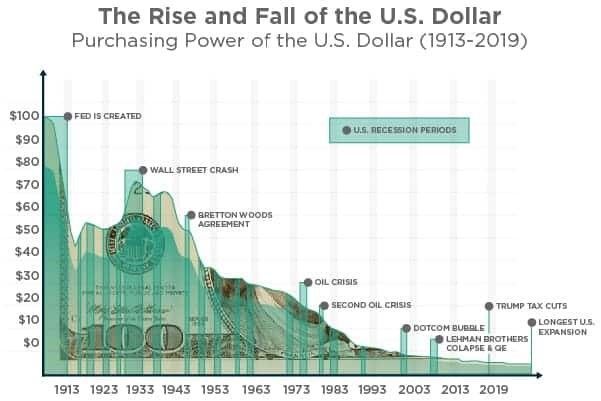
Could we be dealing with delusional psychosis in combination with nefarious actions of certain bankers (i.e., Federal Reserve)?